Why Fiber Optic Splicing Bucket Trucks Matter for Modern Telecom Work
A fiber optic splicing bucket truck is a specialized mobile unit that combines an aerial lift (bucket truck) with a climate-controlled workspace designed for precision fiber optic cable splicing and installation. These trucks integrate three key components:
- Aerial device- Provides liftd access (typically 34-42 feet working height)
- Specialized body- Houses a climate-controlled splicing lab or service body
- Power systems- Generators, inverters, and battery packs to run equipment independently
Key models include:
- Dur-A-Lift DTA2 Series (42-foot working height, 27-foot side reach)
- Versalift Tel-29 (34-foot working height)
- Altec FOSV splicing vans (light-duty and cut-away chassis options)
Fiber optic splicing requires precision. Temperature swings, dust, humidity, and unstable work surfaces can all ruin a splice that needs to be perfect down to the micron. When your team is installing fiber networks across Long Island—from commercial buildings in Nassau County to residential FTTx deployments in Suffolk County—they need more than just a ladder and a toolbox.
The telecom industry has evolved beyond makeshift solutions. Today's fiber splicing crews work from purpose-built mobile workshops that combine aerial access with climate-controlled lab environments. These specialized trucks deliver what traditional bucket trucks cannot: a stable, clean workspace at elevation where technicians can perform fusion splicing with the precision modern networks demand.
Whether you're deploying new fiber infrastructure, performing emergency repairs after a storm, or maintaining existing networks, the right truck directly impacts your splice quality, crew efficiency, and project timelines. The difference between a standard utility truck and a dedicated splicing unit is the difference between working around obstacles and working through them efficiently.
The Anatomy of a Mobile Splicing Unit
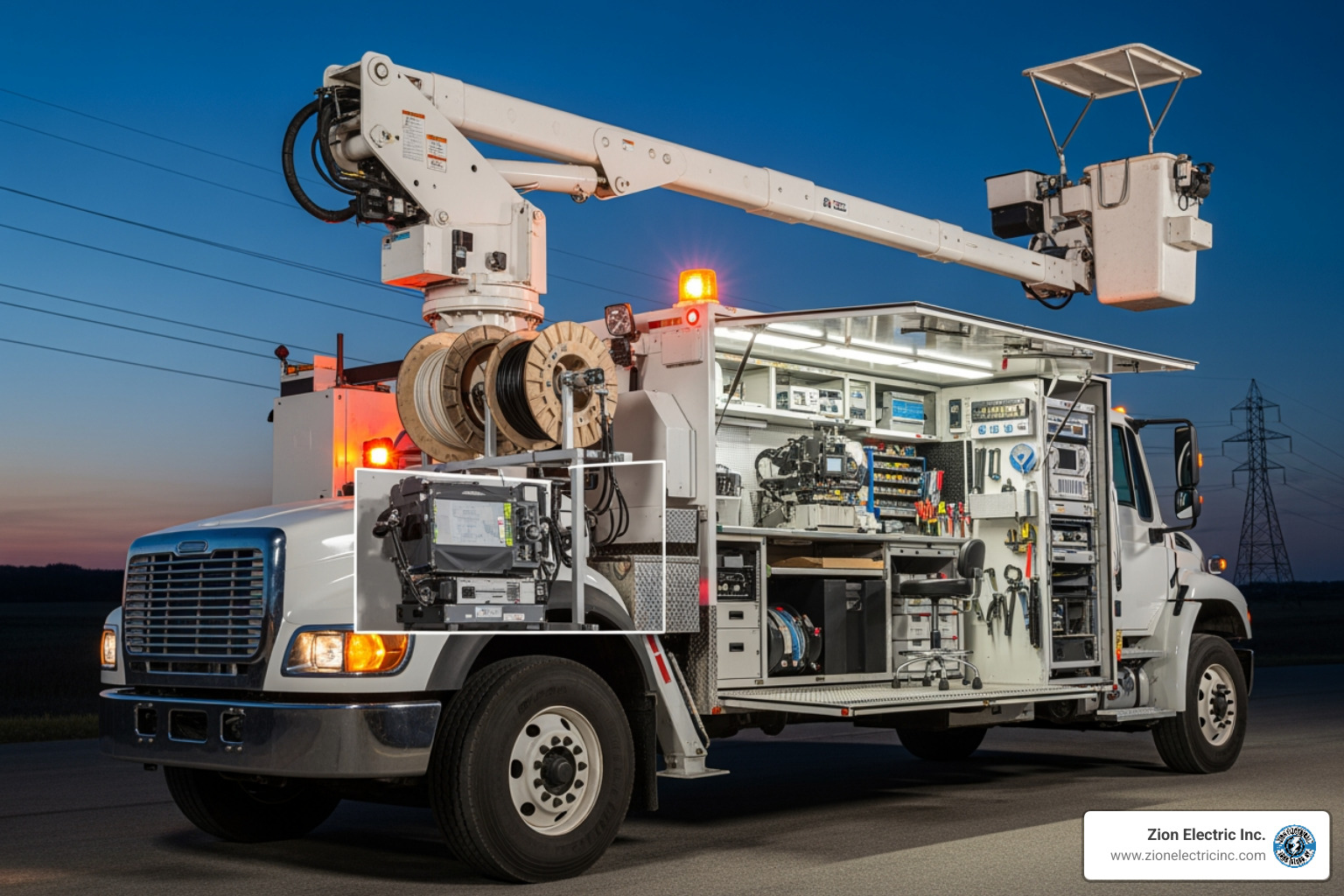
When we talk about a fiber optic splicing bucket truck, we're not just describing a vehicle with a lift. We're referring to an integrated, highly specialized mobile workshop designed to tackle the unique challenges of fiber optic installation and maintenance. This complex machine is built from three core components that work in harmony: the chassis, the aerial device, and the specialized body. Each plays a critical role in creating a truly efficient and effective solution for our telecom professionals on Long Island.
The Chassis: The Foundation of Your Mobile Workshop
Think of the chassis as the backbone of your mobile splicing operation. It's the sturdy frame that supports everything else, from the weight of the specialized body and equipment to the forces exerted by the aerial device. Choosing the right chassis is paramount, as it dictates the truck's overall payload capacity, maneuverability, and durability.
Common types we see in the industry include:
- Truck chassis: Robust and powerful, often used for heavier builds and aerial devices requiring significant stability. Models like the Ford F550 or Ram 5500 are popular choices for their reliability and capacity. For example, a Dur-A-Lift DTA2S-37PC aerial unit might be mounted on a Ford F550 chassis, or a DTA2S-35TS on a Ford 5500 chassis, offering an all-in-one splicing solution.
- Cut-away chassis: These provide a versatile base where a custom body can be mounted behind the cab. The 2025 Versalift Ford E350 Cutaway Splicer Bucket Truck is a prime example, offering a specific platform for a dedicated splicing lab. Altec also offers their FOSV-CA Fiber Optic Splicing Van on a Cut-Away Chassis.
- Light-duty chassis: Ideal for more compact and agile units, often used for vans. Altec's FOSV-L Fiber Optic Splicing Van, for instance, is mounted on a Light Duty Chassis (Class 1 & 2), perfect for navigating tighter urban streets or residential areas across Long Island.
The Gross Vehicle Weight Rating (GVWR) is a critical specification to consider, ensuring the truck can safely carry the aerial device, specialized body, all equipment, and personnel. For instance, the 2025 Versalift Ford E350 Cutaway Splicer Bucket Truck has a GVWR of 11,500 lb, indicating its capacity.
The Aerial Device: Reaching New Heights
The aerial device, commonly known as the "bucket" or "boom," is what allows technicians to reach fiber optic cables strung high on utility poles or other liftd structures. This is where the "bucket truck" part of the name truly comes into play. These devices come in various configurations, each offering distinct advantages:
- Articulating boom: Features multiple sections that "bend" or "articulate," offering excellent maneuverability around obstacles and precise positioning.
- Telescopic boom: Consists of sections that extend straight out, providing significant horizontal reach and often higher working heights.
Key features to look for in an aerial device for fiber optic splicing include:
- Working height: This refers to the maximum height a technician can comfortably work at from the bucket. Common working heights range significantly. For example, the Dur-A-Lift DVS-29 has a 34-foot working height, while the DTA2-35 boasts a 42-foot working height. The 2025 Versalift Ford E350 Cutaway Splicer Bucket Truck also offers a 34' working height.
- Side reach: This measures how far horizontally the bucket can extend from the truck's base. The DVS-29 provides a 21-foot side reach, and the DTA2-35 offers an impressive 27-foot 8-inch side reach, crucial for reaching cables away from the truck.
- Non-insulated boom: Many fiber splicing operations do not involve working on energized power lines, so non-insulated booms (like the Versalift Tel 29 NE) are common, offering a lighter and often more cost-effective solution compared to their insulated counterparts.
- Precise controls: Modern aerial devices, such as those with proportional CAN bus control systems, offer smooth, variable movement for delicate positioning, which is essential when working with fragile fiber optic cables.
The Specialized Body: Your Lab on Wheels
This is arguably the most transformative part of a fiber optic splicing bucket truck, converting a standard utility vehicle into a fully functional, climate-controlled laboratory. These specialized bodies are designed to provide a stable, clean, and comfortable environment for technicians to perform the intricate work of fusion splicing, regardless of external conditions.
- Walk-in units or splicing labs: These are essentially mobile clean rooms. They feature fully enclosed, insulated spaces with ample interior space, often with a 75-inch ceiling height (as seen in the Dur-A-Lift DTA2-35's splicing lab) to allow technicians to stand up and work comfortably. They include dedicated workstations, counter space, and integrated storage solutions for delicate splicing equipment and tools. Brands like Intelli-Care E-Drive Fiber Splicing Lab body, BrandFX Walkin Body, or Reading Splicer Body are designed for this purpose.
- Service bodies: While some service bodies are more general-purpose, specialized versions are outfitted specifically for splicing. They offer organized compartments for tools and equipment, often with a dedicated "splicer door" for easy access to a climate-controlled interior workspace. BrandFX Splicer Body is a common example.
Why a Dedicated Fiber Optic Splicing Bucket Truck is a Game-Changer
In the demanding world of telecommunications, especially with the rapid expansion of fiber optics across communities like ours in Long Island, having the right tools isn't just an advantage—it's a necessity. A dedicated fiber optic splicing bucket truck isn't just a convenience; it's a game-changer for several critical reasons.
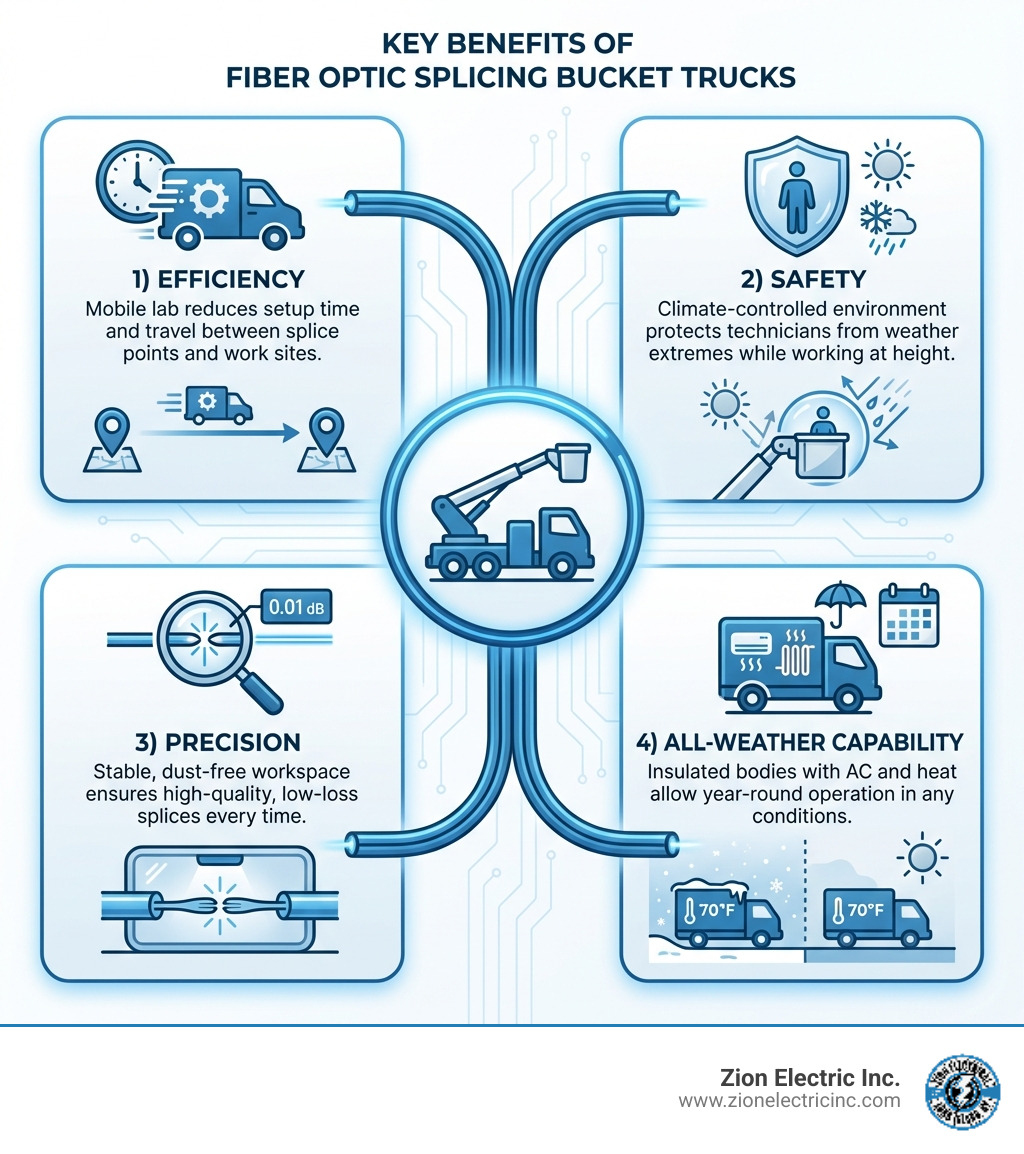
Firstly, let's talk about efficiency. Imagine our crews arriving at a job site. Instead of setting up temporary tents, hauling generators, and constantly battling the elements, they simply deploy the aerial device and step into a pre-configured, climate-controlled lab. This drastically reduces setup time and allows technicians to get straight to work. The ability to perform both aerial access and precision splicing from a single, integrated unit streamlines workflows, minimizes travel between splice points and work sites, and ultimately speeds up project completion for FTTx deployments and network buildouts.
Next, and perhaps most importantly, is safety. Working at height inherently carries risks. A specialized truck provides a stable platform, protecting technicians from wind, rain, and extreme temperatures. Inside the splicing lab, they are shielded from environmental hazards, reducing fatigue and allowing for better focus on the delicate task at hand. This commitment to safety is something we deeply value, aligning with our own emphasis on reliable, high-quality electrical solutions.
All-weather operation is another huge advantage. Long Island weather can be unpredictable, from humid summers to freezing winters. Fiber optic splicing is incredibly sensitive to environmental factors like temperature, humidity, and dust. A dedicated truck with robust climate control means our teams can maintain consistent splice quality year-round, without delays due to adverse weather. This ensures that critical emergency repairs and routine maintenance can proceed uninterrupted, keeping our communities connected.
Finally, the impact on quality control and precision splicing cannot be overstated. A stable, dust-free, and temperature-controlled environment is crucial for achieving low-loss, high-quality splices. Fusion splicers, the core tools for joining fiber optic cables, perform optimally under controlled conditions. By providing this ideal environment, these trucks directly contribute to the reliability and performance of the fiber networks we help build and maintain. This level of precision is what modern high-speed internet demands, and what a dedicated splicing truck delivers.
For us, delivering high-quality, certified installations is paramount. A fiber optic splicing bucket truck empowers our teams to meet these high standards consistently. More info about our certified installations.
Essential Features for Maximum Productivity and Precision
A fiber optic splicing bucket truck is truly a marvel of mobile engineering, packed with features designed to maximize both the productivity of our crews and the precision of their work. From maintaining a perfect environment for delicate fiber strands to ensuring a continuous power supply, every detail contributes to superior splicing quality.
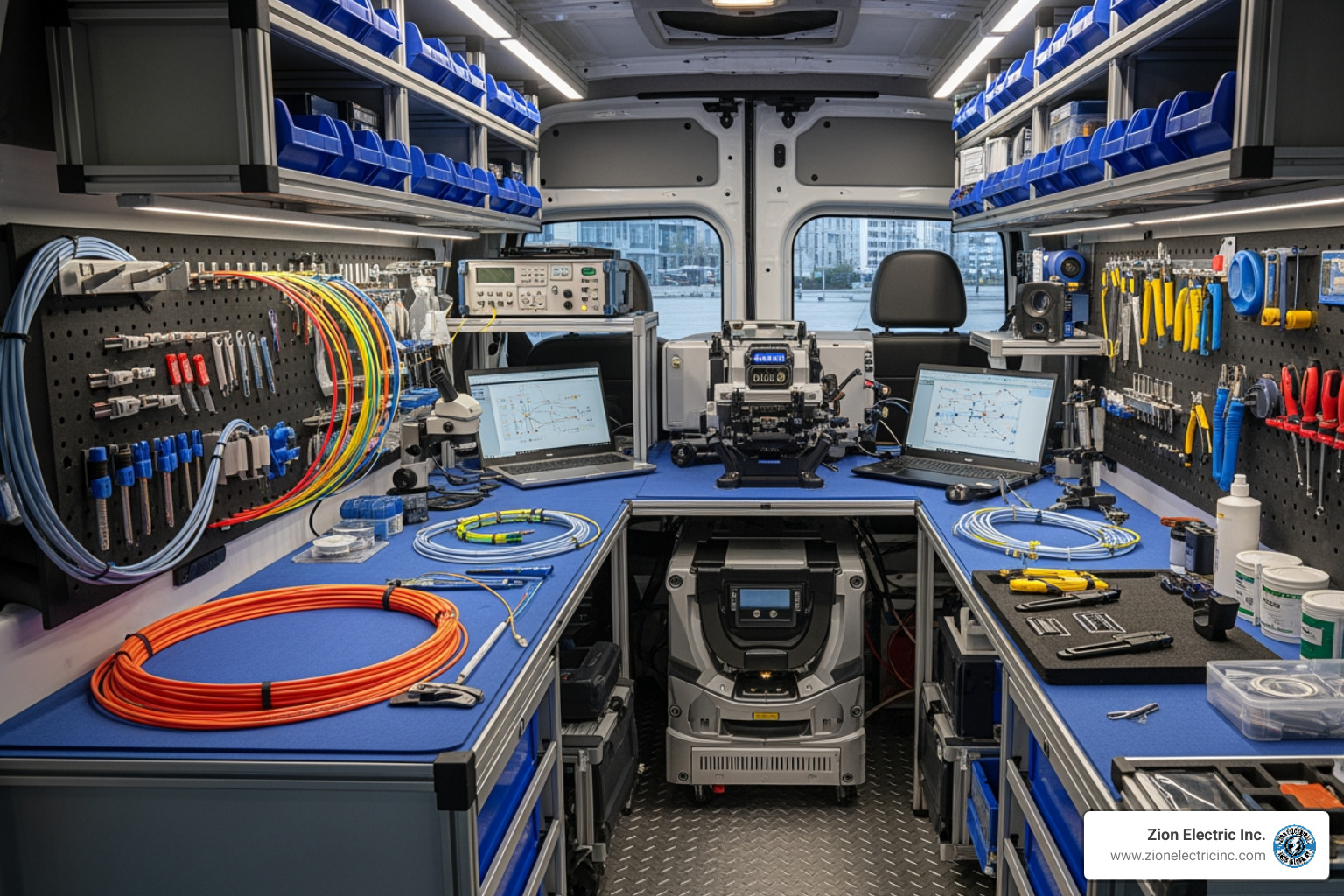
The Climate-Controlled Splicing Environment
The heart of any dedicated fiber optic splicing unit is its climate-controlled environment. Fiber optic fusion splicing is an incredibly precise process, where even microscopic dust particles or slight temperature fluctuations can compromise the integrity of a splice. This is why features like insulation and robust HVAC systems are non-negotiable.
- Roof-mounted AC/Heat units: These systems are designed to maintain a consistent temperature inside the splicing lab, regardless of the weather outside. For example, some units boast a 15K BTU air conditioner with a heat pump and a 1500-watt electric heater. This ensures technicians stay comfortable and, more importantly, that the sensitive fusion splicer and other equipment operate within their optimal temperature ranges.
- Insulation: The walls, floor, and roof of the specialized body are heavily insulated to maintain internal temperatures and reduce energy consumption.
- Humidity control: High humidity can affect fiber cleanliness and splicer performance. A well-designed climate control system helps manage internal humidity levels.
- Dust-free environment: The enclosed nature of the splicing lab, combined with proper ventilation, minimizes dust and airborne contaminants that could interfere with a perfect splice.
By creating this stable, clean working environment, we ensure optimal fusion splicer performance, leading to the low-loss, high-quality splices that are the hallmark of reliable fiber optic networks.
Powering Your Operations: Key Electrical Systems for a fiber optic splicing bucket truck
Keeping all the specialized equipment running – from the fusion splicer itself to lighting, heating, and cooling – requires a robust and reliable power system. These trucks are designed to be self-sufficient, allowing our crews to work efficiently even in remote locations or during power outages.
- Generators: Often mounted externally, generators provide primary power for the splicing lab and its equipment. The Honda EU3000 is a popular choice, known for its quiet operation and reliability. Altec's splicing vans and trailers feature generators ranging from 5.5 kW to 7.0 kW.
- Inverters: These devices convert DC power from batteries into AC power, allowing standard electrical equipment to be run. A 2400-Watt Pure Sine Wave Inverter, for instance, provides clean, stable power essential for sensitive electronics.
- Lithium battery packs: Modern trucks increasingly use high-capacity lithium battery packs (e.g., three 5.1 kWh lithium battery packs, forming a 48-volt DC system) coupled with powerful inverters (4kW continuous, 9kW peak). This advanced E-Drive system allows the splicing lab and even the aerial lift to operate independently of the chassis engine for extended periods.
- Shore power connections: A standard 30-amp shore power connection allows the truck's batteries to be recharged and the internal systems to be powered when parked at a facility, reducing reliance on the generator.
- 110-volt outlets: Multiple outlets are strategically placed throughout the splicing lab to power tools, test equipment, laptops, and charging devices.
- Idle mitigation systems: These systems, often tied into the battery/inverter setup, allow the engine to be turned off while still powering the splicing lab, significantly reducing fuel consumption, emissions, and noise pollution—a benefit for both the environment and technicians working long hours.
Ensuring these complex electrical systems are correctly installed and maintained is crucial for uninterrupted operations. We understand the importance of reliable power, and our expertise in general electrical services extends to these specialized mobile units.
Customization for Best Efficiency
One of the greatest strengths of a dedicated fiber optic splicing bucket truck is its capacity for customization. Every crew has unique preferences and workflow needs, and the ability to tailor the truck's features can significantly improve usability and efficiency.
Here are some common customization options we see:
- Custom workbenches: Designed to technician specifications, providing ergonomic workspaces for fusion splicers, cleavers, and other tools.
- Interior LED lighting: Bright, energy-efficient lighting ensures optimal visibility for intricate splicing tasks, even in low-light conditions.
- Exterior work lights: Positioned to illuminate the work area around the truck and the aerial bucket, enhancing safety and visibility during night operations.
- Cable entry doors: Specialized doors (Altec models feature 2 cable entry doors) allow fiber optic cables to be brought into the climate-controlled lab without compromising the internal environment.
- Tail shelves: Convenient pull-out or fixed shelves at the rear of the truck provide additional workspace or storage for equipment like generators.
- Tool storage: Integrated, organized compartments and shelving keep specialized fiber optic tools secure, accessible, and protected from damage.
- Safety rails: Added to work platforms or around the truck for improved technician safety.
These custom features transform a standard vehicle into a highly personalized and efficient mobile workplace, ensuring our technicians on Long Island have everything they need to perform their best.
Choosing the Right Aerial Device and Body Type
Selecting the perfect fiber optic splicing bucket truck isn't a one-size-fits-all decision. The optimal configuration depends heavily on the specific applications, typical working environments, and the preferences of the crews using it. It's about finding the right balance between aerial reach and a functional, comfortable lab space.
Selecting the Right Aerial Device for the Job
The aerial device, or boom, is critical for gaining access to overhead fiber infrastructure. Its specifications directly impact where and how effectively our crews can work.
- Working height ranges: The required working height is a primary consideration. For many aerial fiber installations and repairs, a 34-foot working height (like that offered by the Dur-A-Lift DVS-29 or the Versalift Tel 29 NE) is sufficient. However, for higher utility poles or more complex infrastructure, a 42-foot working height (as seen with the Dur-A-Lift DTA2-35) provides greater versatility. We always assess the typical pole heights and cable locations our technicians will encounter on Long Island.
- Side reach needs: Equally important is the side reach, which determines how far horizontally the bucket can extend from the truck. A 21-foot side reach (DVS-29) is good, but a 27-foot 8-inch side reach (DTA2-35) offers significantly more flexibility, allowing technicians to reach cables over obstacles or without repositioning the truck as frequently.
- Articulating vs. Telescopic booms: As discussed, articulating booms offer excellent maneuverability in tight spaces, useful for navigating urban environments or cluttered utility poles. Telescopic booms excel at providing straight, extensive horizontal and vertical reach, often preferred for straightforward access. The choice depends on the typical obstacles and access points crews face.
Walk-In Splicing Labs vs. Service Bodies for your fiber optic splicing bucket truck
The choice between a dedicated walk-in splicing lab and a service body with a splicing compartment is a significant one, impacting technician comfort, workflow, and overall functionality.
| Feature | Walk-In Splicing Lab Comparison Table:
| Feature | Walk-In Labs Service Bodies:
| Feature | Service Bodies Service Bodies: These are mobile units designed to house specialized equipment.
We will focus on the following models:
- Altec's FOSV-L Fiber Optic Splicing Van: Mounted on a Light Duty Chassis (Class 1 & 2), this van offers a 7.0 kW generator and 13,500 BTU A/C.
- Altec's FOSV-CA Fiber Optic Splicing Van: Mounted on a Cut-Away Chassis, this also features a 7.0 kW generator and 13,500 BTU A/C.
- Altec's FOST 610 Fiber Optic Splicing Trailer: A Tandem Axle Trailer with dimensions 6’x10′, offering a 5.5 kW generator and 13,500 BTU A/C.
- Altec's FOST 712 Fiber Optic Splicing Trailer: A larger Tandem Axle Trailer at 7’x12′, also with a 5.5 kW generator and 13,500 BTU A/C.
- Dur-A-Lift DTA2S-37PC and DTA2S-35TS aerial units: Often integrated into custom splicing lab bodies on Ford F550 or 5500 chassis.
- Dur-A-Lift DVS-29 and DTS-29 aerial units: Frequently paired with BrandFX service bodies on Ford F550 or F-450 chassis.
Frequently Asked Questions about Fiber Splicing Trucks
We often receive questions about the specifics of these incredible machines. Here are some of the most common inquiries we address for businesses looking to improve their fiber optic capabilities on Long Island.
What is a typical working height for a fiber splicing bucket truck?
The working height of a fiber optic splicing bucket truck is one of its most important specifications, directly impacting its utility for various aerial tasks. While heights can vary, common working heights range from 34 to 42 feet. For instance, the Dur-A-Lift DVS-29 offers a 34-foot working height, and the 2025 Versalift Ford E350 Cutaway Splicer Bucket Truck also has a 34' working height. For jobs requiring more reach, models like the Dur-A-Lift DTA2-35 provide an impressive 42-foot working height.
Coupled with working height, side reach is also crucial. These trucks typically offer side reach capabilities often exceeding 21 to 27 feet. The DVS-29 has a 21-foot side reach, while the DTA2-35 extends over 27 feet 8 inches. These ranges allow technicians to access most aerial cables easily, whether they are directly above the truck or positioned further out from the vehicle.
Why is climate control so important in a splicing truck?
Fiber optic fusion splicing is a precise process that is highly sensitive to environmental conditions. Temperature, humidity, and even microscopic dust particles can significantly impact the quality and reliability of a fiber splice. Climate control is therefore critical in a splicing truck for several reasons:
- Precision: Fusion splicers, the devices used to join fiber ends, require stable operating temperatures to function accurately. Extreme heat or cold can affect their calibration and performance, leading to poor quality splices with high signal loss.
- Fiber integrity: Fiber optic cables themselves can be affected by temperature extremes. Rapid changes can cause expansion or contraction, making precise alignment difficult. Humidity can also cause issues with fiber cleaning and preparation.
- Dust-free environment: Even the smallest dust particle trapped in a splice can cause significant signal attenuation. A climate-controlled, enclosed lab helps maintain a clean, dust-free environment, which is essential for achieving low-loss, high-quality splices.
- Equipment protection: Sensitive and expensive splicing equipment, test gear, and laptops are protected from harsh weather conditions, extending their lifespan and ensuring consistent performance.
- Technician comfort and productivity: A comfortable working environment allows technicians to maintain focus and precision, especially during long hours or in challenging weather conditions, enhancing overall productivity and safety.
Climate control ensures that every splice performed in the truck is of the highest possible quality, protecting the integrity of the fiber optic network.
Can these trucks be powered without running the engine?
Yes, many modern fiber optic splicing bucket trucks are designed with advanced electrical systems that allow the splicing lab and even the aerial lift to operate for extended periods without the chassis engine running. This is a significant technological advancement driven by efficiency and environmental concerns.
These systems typically include:
- High-capacity lithium battery packs: Such as three 5.1 kWh lithium battery packs, which store a substantial amount of energy.
- Powerful inverters: Like a 2400-Watt Pure Sine Wave Inverter (or a 4kW continuous/9kW peak inverter), which convert the battery's DC power into the AC power needed for all the equipment.
- Shore power connections: A standard 30-amp connection allows the batteries to be recharged and systems to be powered when the truck is docked or at a facility.
This setup enables what's often called an "E-Drive" or "idle mitigation" system. The benefits are numerous:
- Reduced noise pollution: Operating silently is a huge advantage, especially in residential areas or during night work.
- Lower emissions: Eliminating engine idle significantly cuts down on exhaust fumes, making the working environment healthier for technicians and reducing the truck's environmental footprint.
- Fuel savings: Less engine run time means less fuel consumed, leading to substantial cost savings over the truck's lifespan.
- Extended engine life: Less idling reduces wear and tear on the truck's engine.
This capability ensures that our crews on Long Island can work efficiently and responsibly, minimizing their impact while maximizing their output.
Conclusion: Equipping Your Team for Success
In the rapidly expanding world of fiber optic networks, the fiber optic splicing bucket truck stands as an indispensable tool. It's more than just a vehicle; it's a mobile command center that embodies efficiency, quality, and safety. For businesses like ours, servicing the dynamic communities of Long Island, investing in the right equipment means investing in the future of reliable, high-speed connectivity.
From the robust chassis that forms its foundation to the precision aerial device that provides access, and the climate-controlled lab that ensures perfect splices, every component of these specialized trucks is designed to empower technicians. The ability to customize these units further improves their usability, making them custom solutions for specific operational needs.
We understand that the success of modern telecommunications infrastructure hinges on the quality of every connection. A dedicated fiber optic splicing bucket truck ensures that our teams can deliver that quality consistently, efficiently, and safely, regardless of the challenges presented by the environment or the complexity of the project.
For complex electrical systems and specialized equipment installations, trusting an expert is key. Zion Electric Inc. has the experience to ensure your mobile operations are powered safely and reliably. Learn more about how our Specialty Services can support your telecommunications infrastructure needs.